




From the magazine
Jyamiti & Sea
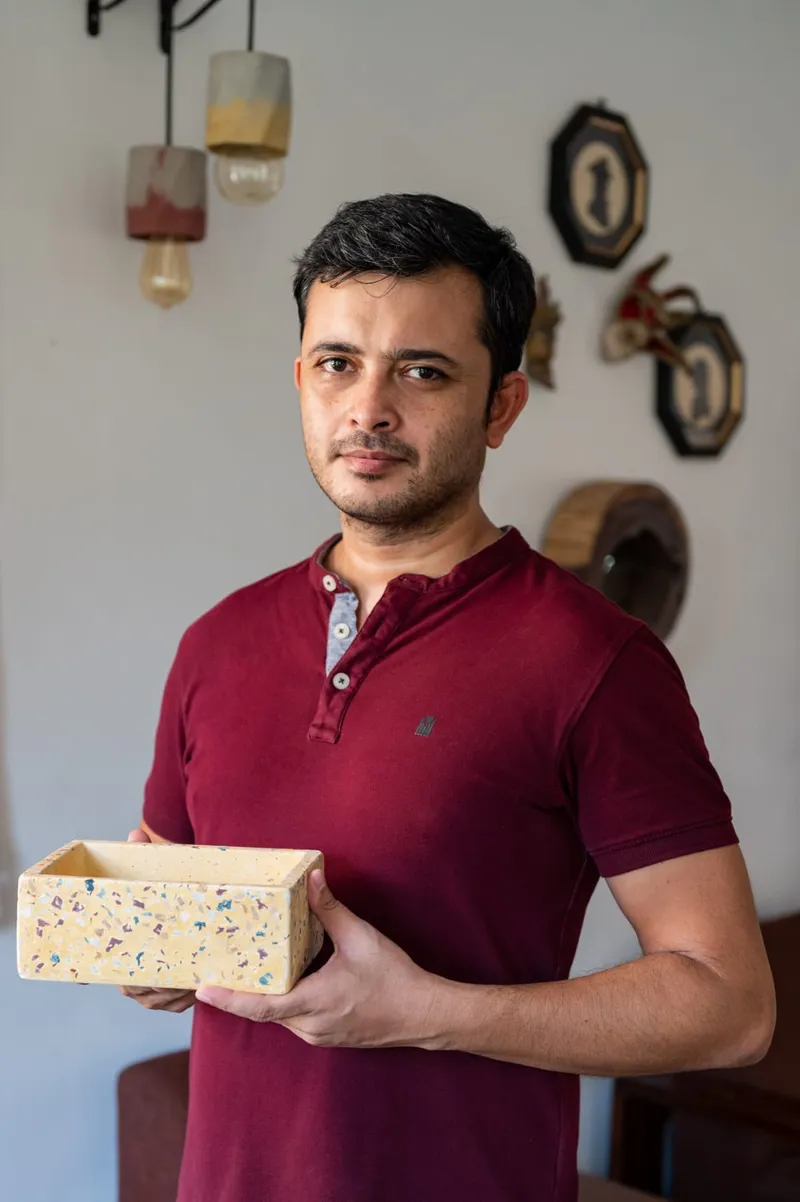
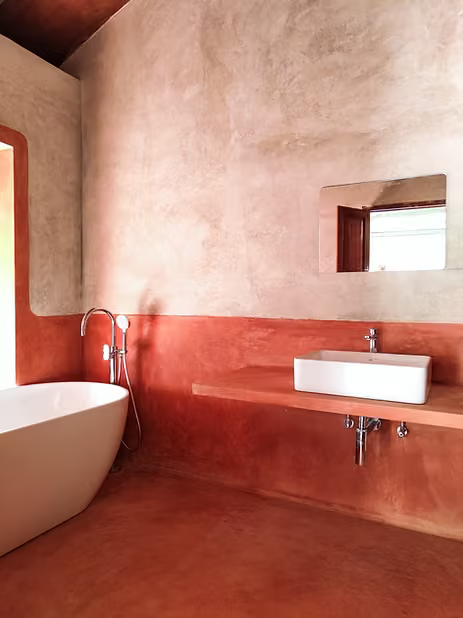
In a world increasingly shaped by factory-made finishes and standardised surfaces, Jyamiti & Sea is taking a different approach. Based in Goa, with a second base of operations in Bengaluru, the terrazzo and IPS manufacturing studio is bringing renewed attention to materials that were once an integral part of Indian homes. Through handcraft, contemporary cement technology and a strong sensitivity to colour and form, the studio creates surfaces that are designed not merely to be seen, but to be lived with.
The name itself captures the philosophy behind the brand. “Jyamiti”, the Bengali word for geometry, reflects the structured and mathematical character of the material, while “Sea” acknowledges Goa, the coastal setting that has become central to the studio’s identity. At the heart of the venture is founder Soumak Mukhopadhyay, whose route into material craft was anything but conventional.
From Technology to Material Craft
Soumak’s professional journey began far from the world of construction and design. He spent close to a decade at Infosys, progressing from a developer to a project manager while working on international assignments in Switzerland, the UK and France. His career later took a creative turn when he co-founded The Creative Lens, a photography studio that he ran for more than ten years.
Photography gave him an understanding of composition, detail, light and visual storytelling. Yet after years behind the camera, he found himself drawn towards something more tangible, the opportunity to create with his own hands.
That transition has had a lasting influence on Jyamiti & Sea. His technology background contributes a process-oriented approach, while his years in photography have cultivated an instinct for visual balance and detail. Together, these experiences have shaped a studio that approaches material making with both precision and curiosity.
A Lockdown Experiment That Became a Studio
The origins of Jyamiti & Sea can be traced back to an unlikely beginning during the Covid-19 lockdown. With time spent indoors and a desire to explore something new, Soumak enrolled in an online course that cost just ₹300.
What began as a low-risk experiment quickly became a hands-on exploration of concrete and home décor. He began making pieces himself, learning through experimentation and gradually becoming more interested in the possibilities of the material. The project continued to evolve long after the initial curiosity had passed. Those early experiments eventually developed into a larger vision, giving rise to Jyamiti & Sea.
Terrazzo Rooted in Memory
For Soumak, terrazzo carries a strong sense of nostalgia. Growing up in Kolkata, he encountered the material as an ordinary part of everyday surroundings. Art Deco homes, stairwells, courtyards and residential spaces often featured terrazzo flooring, making it a familiar part of the urban landscape rather than a specialised design statement.
That early relationship with the material continues to influence the studio’s approach. Jyamiti & Sea does not treat terrazzo simply as a fashionable finish. Instead, the brand sees it as a material with history, one that belongs to lived spaces and becomes more meaningful through use. Its surfaces are intended to be touched, walked on and incorporated into everyday life.
This perspective also informs the studio’s broader interest in reviving terrazzo and IPS, both of which were once widely used in Indian homes before factory-made alternatives gradually displaced them.
Giving Concrete a Softer Identity
Concrete is often associated with strength, utility and industrial spaces. Jyamiti & Sea challenges that perception by exploring the softer, more expressive side of the material.
Colour is incorporated directly into the concrete through oxide pigments before the material is poured. Rather than applying colour as a superficial layer, the pigment becomes part of the material itself. This creates surfaces where colour is structurally integrated and ages alongside the concrete.
The studio further softens the visual language of concrete through rounded edges and organic forms. The result is a material that can feel warm and tactile while retaining the strength and durability traditionally associated with concrete.
Handmade From Beginning to End
The studio’s work spans a variety of applications, including tabletops, countertops, slabs, flooring and wall finishes. While the finished surfaces may appear refined and precise, their production remains firmly rooted in handcraft.
Each piece is mixed, pigmented, poured, ground and finished by hand. There is no mass-production line dictating the outcome. Instead, skilled artisans guide the material through each stage of its transformation.
This approach is particularly evident in the creation of patterns. Different pigmented batches are carefully poured and zoned within a single piece, creating compositions that emerge from a combination of planning, technique and the natural behaviour of the material.
Every commission can therefore become its own design exercise. The studio works with clients and designers to develop custom colours, patterns and formats, allowing surfaces to respond to individual spaces rather than being limited to a fixed catalogue.
Traditional Craft Meets Modern Science
While the process remains handmade, Jyamiti & Sea has also recognised the importance of contemporary material science. To strengthen the performance and reliability of its surfaces, the studio has worked with cement technology experts at IIT Chennai.
This collaboration has helped update traditional terrazzo and IPS formulations to address issues such as cracking and inconsistency that could historically make hand-poured surfaces difficult to rely on.
The technology remains largely behind the scenes. Its purpose is not to replace the craft, but to support it, allowing artisans to continue working with their hands while producing surfaces that meet contemporary expectations for durability, consistency and design flexibility.
The Beauty of the Unrepeatable
One of the defining characteristics of Jyamiti & Sea’s work is that no two pieces are exactly alike. Because every surface is hand poured and hand finished, and because pigments are incorporated directly into the material, each piece develops its own character. There is an element of unpredictability in how colours settle, interact and reveal themselves once the material cures. Rather than attempting to eliminate that variation, the studio embraces it.
For Jyamiti & Sea, these subtle differences are not imperfections. They are evidence of the human process behind the work. Each surface carries the marks of decisions made during pouring, finishing and polishing, giving it a character that a printed or mass-produced finish cannot replicate.
The Hands Behind the Material
Behind this philosophy is a team of 25 artisans working across Goa and Bengaluru. Their contribution extends through every stage of production, from mixing pigments and preparing batches to pouring, grinding and polishing finished surfaces.
Their skill is central to the studio’s identity. Jyamiti & Sea views the preservation of this knowledge as an important part of its purpose, particularly at a time when many traditional material practices have been replaced by industrial manufacturing.
The studio is therefore not only producing surfaces; it is helping sustain a craft tradition by giving artisans an opportunity to continue developing and passing on their expertise.
Designed to Age With Grace
Despite the craftsmanship involved, caring for Jyamiti & Sea surfaces is relatively straightforward. Regular mopping is sufficient for everyday maintenance, while mild detergents are recommended instead of harsh chemicals.
The material is also intended to age rather than remain permanently unchanged. Over time, its surface can develop character, allowing the signs of use to become part of its story.
That quality reflects the studio’s fundamental philosophy: materials need not remain frozen in their original condition to remain beautiful. A surface that changes naturally through everyday life can become more personal with time.
A Practice Shaped by Many Journeys
Soumak’s transition from technology to photography and eventually material craft is reflected in the character of Jyamiti & Sea. His years in international corporate environments brought structure and process; photography developed his sensitivity to composition and visual detail; and working between Bengaluru and Goa has placed him in environments where contemporary design and local material traditions intersect.
Jyamiti & Sea brings these influences together through an approach that is simultaneously technical and tactile. Its work respects the history of terrazzo and IPS while looking for ways to make them relevant to contemporary spaces.
At its core, the studio is making a case for slowing down. In an industry increasingly dominated by speed and uniformity, it places value on skilled hands, individual variation and materials that reveal their character over time. For Jyamiti & Sea, geometry may provide the structure, but it is craftsmanship, colour, memory and the unpredictable nature of making that give each surface its soul.