
~ The Palakkad Chair designer reflects on craft traditions, design practice and artisan livelihoods during MOG Sunday session
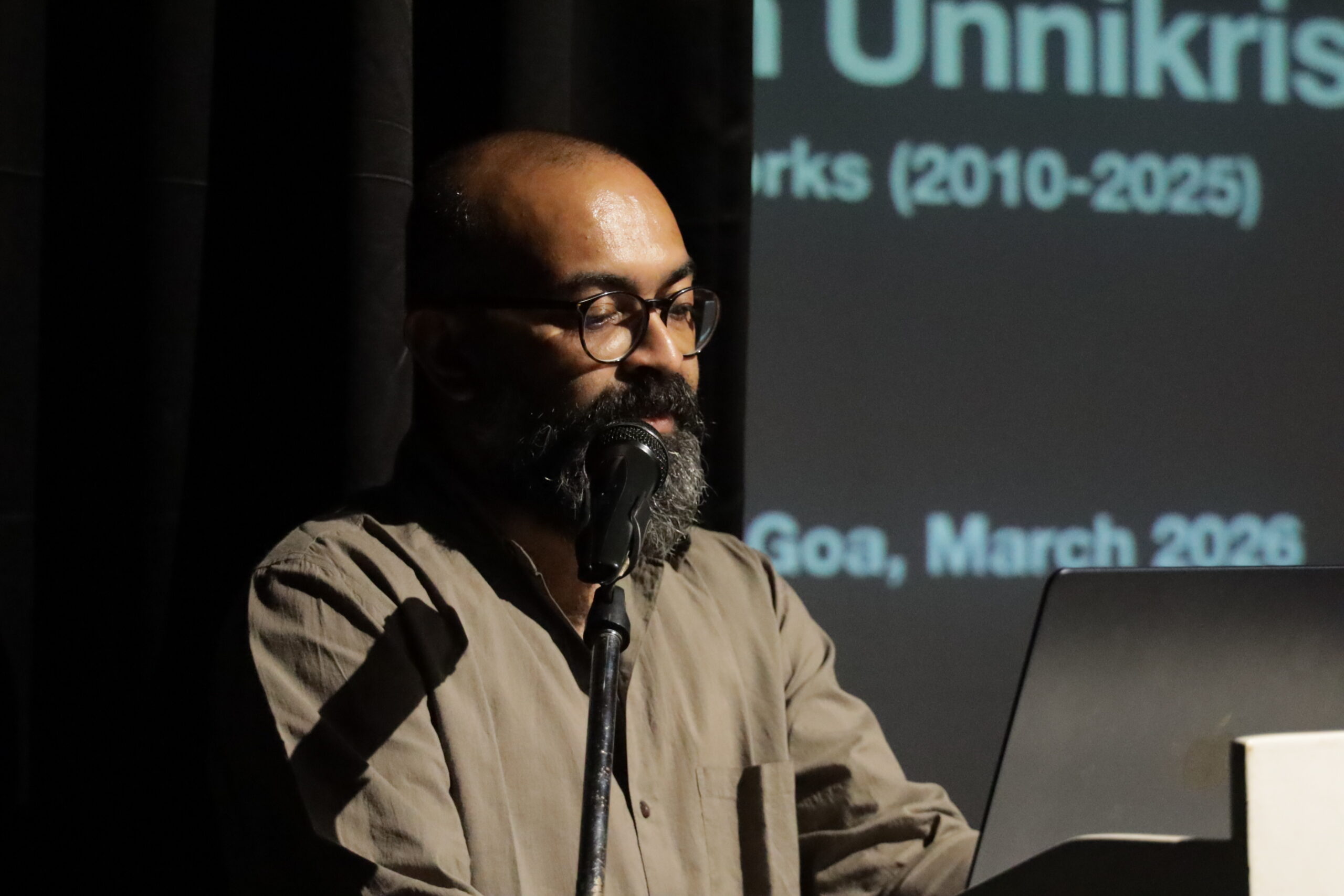
Panaji, March 2026: Goa’s furniture still carries visible traces of its colonial past and its heavy wooden pieces, carved cupboards and cane-backed chairs found in many older homes reflect centuries of Portuguese influence on local craft traditions, according to artist and designer Nityan Unnikrishnan, who used this context to reflect on how furniture-making traditions in Goa and Kerala evolved along different paths.
Speaking at a MOG Sunday session at the Museum of Goa, Unnikrishnan said that while both regions share humid coastal climates and access to similar woods, their craft traditions developed differently. Goa’s furniture retains clear colonial influences in its forms and materials, while Kerala’s traditions emerged through different craft practices and techniques. “Craft traditions usually develop out of the materials, the climate and the people who work with them,” Unnikrishnan said. “Goa’s furniture has very clear colonial influences,” he said, adding that Kerala’s traditions evolved through different craft practices.
The Palakkad Chair itself began as a personal project for him in 2013, when Unnikrishnan designed a wooden chair as a birthday gift for a friend. The design later evolved through several iterations and collaborations, eventually becoming the iconic Palakkad Chair now produced with the furniture design studio Phantom Hands.
Inspired by the work of American woodworker and architect George Nakashima, the wood-and-cane chair gradually evolved through several iterations before taking its present form in collaboration with Phantom Hands. Unnikrishnan’s practice spans painting, design and collaborations with traditional artisans across India. Trained in industrial design, he has also worked as a ceramic designer and explored furniture-making. His work has been featured in several solo and group exhibitions over the past decade and is currently on view at the 6th Kochi Muziris Biennale in Kerala.
Speaking about the influences behind the design, Unnikrishnan referred to the work of Japanese-American woodworker George Nakashima and his approach to combining craftsmanship with design. “Designing and making for me… it’s not two separate things, it’s just one and the same,” he said.
Reflecting on his practice across painting, ceramics and furniture, Unnikrishnan noted that designing objects intended for wider production requires a different approach from creating artworks. “I was clear that I was not doing it for myself,” he said. “It has to be easy to be made… it can’t cost beyond a point.”
Returning to the subject of traditional craftsmanship, Unnikrishnan said designers often misunderstand the needs of artisans. “What they need help with is to find better ways to make a living,” he said. “They don’t need help to design.”
He added that despite the growing popularity of handmade products in global markets, the economic benefits rarely reach artisans themselves. “Nothing really benefits the artisans,” he said, noting that while handmade design is widely consumed, the work often remains concentrated in small pockets and does not translate into sustainable livelihoods for craftspeople across the sector.