
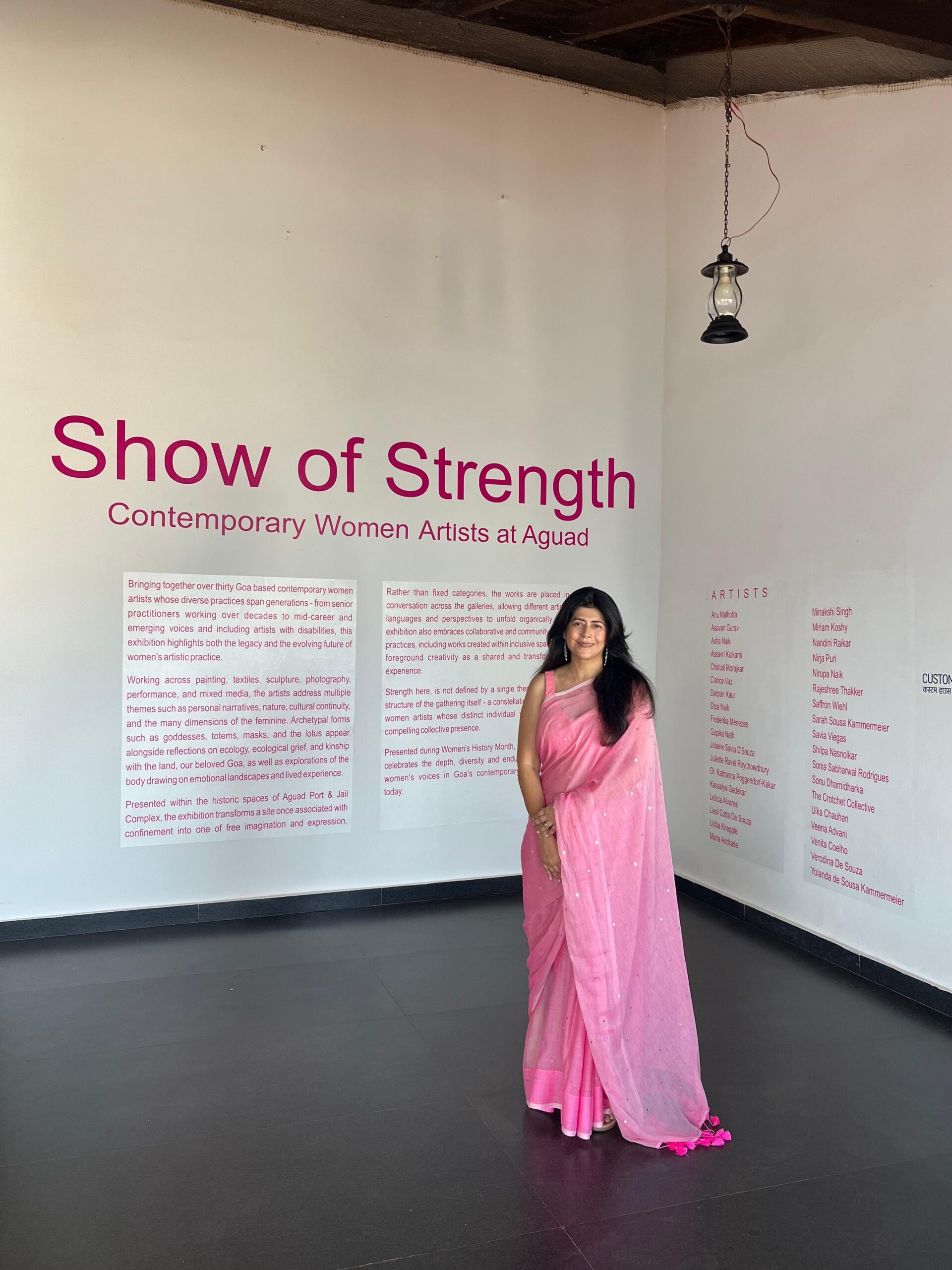
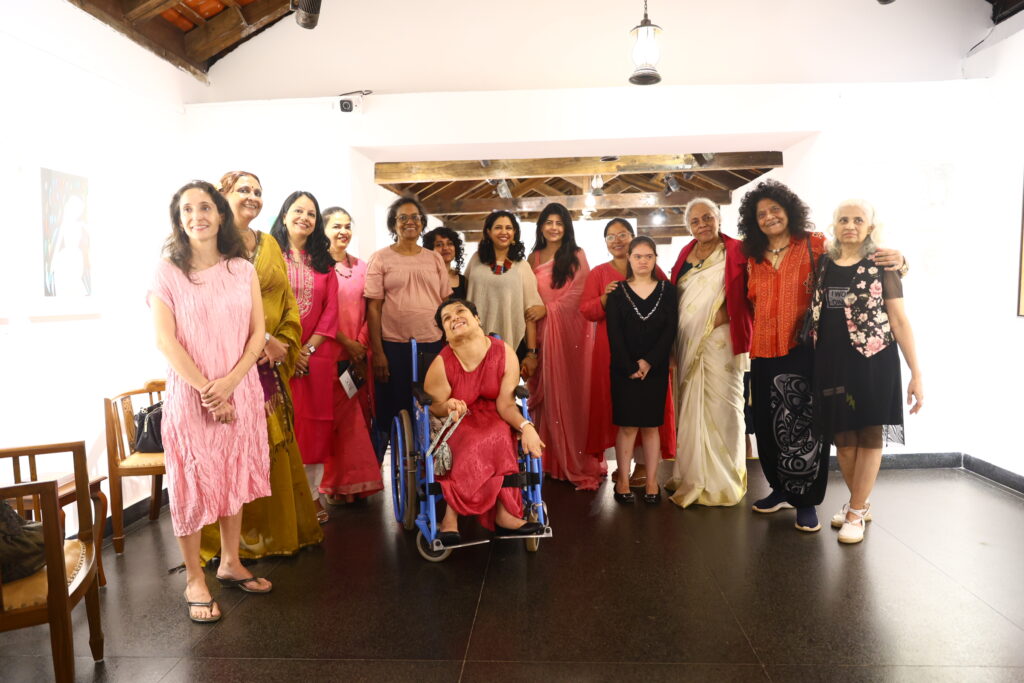
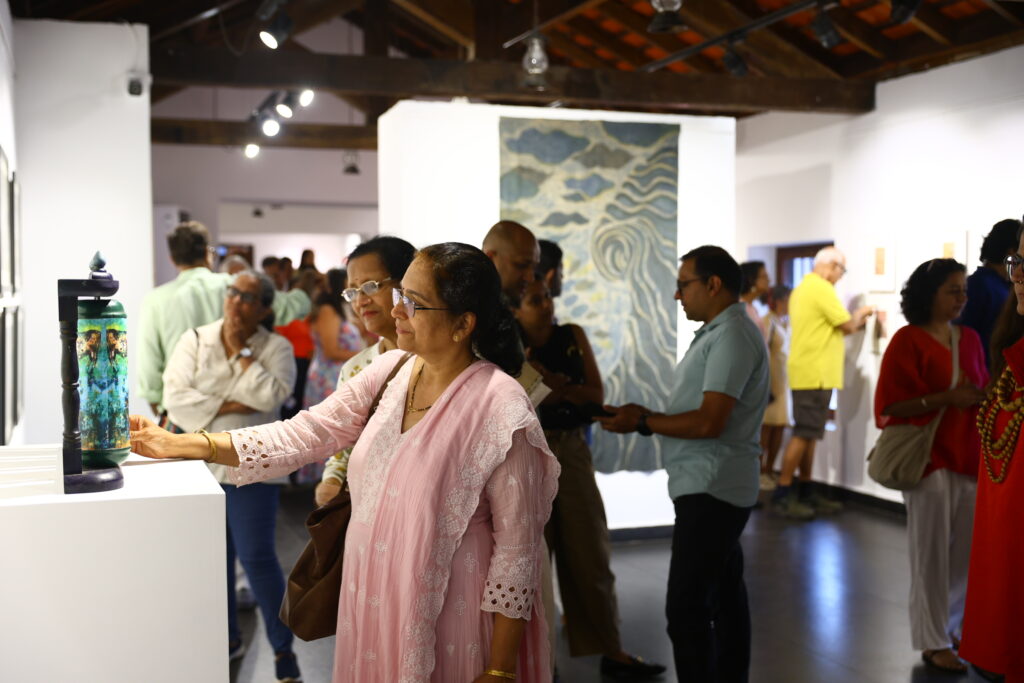
The exhibition ‘Show of Strength’ is currently underway at the Aguad Port and Jail Complex, bringing together a group of women artists from across Goa. Individually they may be works across mediums – painting, sculpture, photography, installation, textile and mixed media; but together, they honour the visible and invisible forms of strength carried by women: spiritual, cultural, ecological and personal. Curator Samira Sheth has left no stone unturned in prepping, designing and curating the show. In this tete-a-tete, Samira shares her vision for the exhibition and why the venue makes a deeper impact when the viewer contemplates the artwork
What inspired the title ‘Show of Strength’, and what was your process for selecting the featured artists and works?
I wanted this exhibition to mark Women’s History Month worldwide, moving beyond just another group show of women artists. I wanted to offer a significant, honest portrayal of works that are deeply authentic. From established artists, with decades of experience, like Nirupa Naik, Yolanda de Sousa, Gopika Nath, to those newer emerging voices who have impressive commitment. This includes Maria Andrade – a neurodivergent – from Divya Sadan, who wakes up every morning only to paint and Frederika Menezes who painstakingly creates her vibrant digital paintings using one finger on a tablet.
As a curator, I wanted to bring together these real voices, works that don’t try to fit into a trend. The diverse representation for women artists based in Goa adds perspective to a larger conversation through the works – painting, photography, textile, crochet, sculpture, ceramics, digital art, installation and performance art – making a significant statement in itself and hence the title Show of Strength.
What did you enjoy the most about curating Show of Strength?
I have worked with most of the artists over the 15 years I’ve worked in Goa, while a few were newer discoveries for me. Building visibility for artists – finding artists, learning about their individual practice and visual language, bringing these diverse voices together and showing them to best effect – gives me great joy. I cherish the fact that senior artists and the emerging ones trust me as curator. I love the appreciation this show has garnered, drawing in a significant number of visitors, while positioning these artists as the strong creative forces onto a singular platform. It’s highly rewarding that my work of over a decade in the Goa art scene is recognized when people ask me how I’ve connected with so many artists.
What are your thoughts on the historical representation of women in art?
Historically, women (or the female form) have been central to art but mostly as subjects, muses, or symbols, rather than as active authors of their own narratives and history focuses on how the male gaze represented women and shaped ideas of beauty, identity and even power. There’s an interesting work by New York based group Guerilla Girls which asked “Do Women Have to be Naked to get into the Met. Museum?”(1989) They questioned how less than five percent of artists in the museum section were women and yet 85 percent of the nudes on view were female! While we’ve seen attempts towards more representation since then, as a curator, I think the conversation today is less about including women, and more about reframing authorship and perspective. In my work, I’m drawn to more individualistic voices – whether by a male or female artist – that tell stories. I also like works where women are not just visible, but are shaping how they are seen and understood as well as shaping the cultural narrative of Goa and the country.
What impact do you hope for with this show?
I have always championed artists in Goa because there is a wealth of original art here from distinctive artists, who deserve to be positioned within the contemporary art discourse. I like that the show is drawing in audiences from all walks of life – residents and tourists, adults and children. In the fast-paced world of AI and quick consumption, I’m relishing the gift of our audience’s attention. I think people should see this show because it offers a different pace of looking at multiple perspectives.
I’ve always wanted art to become a part of the cultural consciousness of Goa. If you go to Amsterdam or Italy you know who Van Gogh and Michelangelo are – they are part of the cultural fabric of these places. Kids in Goa don’t know about our artists like VS Gaitonde and FN Souza as much, they’re not taught. With this show, I want these women artists – established legacies alongside emerging talent – to be recognized for their practices that are central to Goa’s evolving cultural fabric.
What are the societal or cultural themes that are represented in this exhibition?
This exhibition maps the diverse visual languages of 37 artists, beginning with the divine and resilient strength found in the goddesses drawn by Nirupa Naik, Sonia Rodrigues Sabharwal, and Venita Coelho, alongside the elemental forces in the totems of Anu Malhotra, Nandini Raikar’s lotus artworks, and the installations of Rajeshree Thakker’s large textile work and Katharina Kakar’s Tantric Buddhist Dakini Tapovan. The focus shifts to internal emotional landscapes and personal journeys, expanding sense of inner freedom and female solidarity through the works of Leticia Alvares, Gopika Nath, Verodina de Souza, Liesl Cotta de Souza, Nirja Puri, and Asavri Gurav, while Darpan Kaur, Chaitali Morajkar and The Crochet Collective (including the works from Divya Sadan with artists Maria, Jolaine and facilitator Lioba Knepple) use texture and form to explore the burdens women bear, their inner psyche and the release of inner limitations absorbed as children. The narrative is also deeply rooted in land and labour, highlighting the “invisible” work of indigenous women as seen in the paintings and textile works of Clarice Vaz, Minakshi Singh, Asha and Dipa Naik, and Savia Viegas. Finally, Goa serves as a vital anchor, with artists Miriam Koshy, Loretti Pinto, Juliette Ravel Roychowdhury, Kausalya Gadekar, Saffron Wiehl, and Sonu Dharnidharka reflecting on its changing ecology, culture and milieu, while Yolanda de Sousa, Assavri Kulkarni, and Ulka Chauhan capture its social fabric and Shilpa Nasnolkar and Veena Advani bridge these local identities with global, world-spanning narratives
Coming to your personal journey, what is your earliest memory of art? And what propelled curation as a career choice?
My earliest memory of art revolves around a print of Toulouse-Lautrec my parents bought back from a trip to Europe. I’d spend hours looking at it and wanting to know more about the painting. I’ve always been drawn to art, being surrounded by works my parents collected. I was always interested in how meaning is constructed, whether through text or visuals. So, curation felt like a natural extension of how I think and what I’m drawn towards. I was interested not just in individual artworks, but in how they speak to each other – how placing works together can create new meanings and conversations and how an exhibition becomes something you can move through and experience.
How did Aguad – a site of historical confinement – play a role as a space for freedom of expression and become the ideal venue to amplify these women’s creative voices?
Choosing Aguad as a venue was intentional; its history of control and confinement, originally built to regulate movement and assert power, provides a powerful contrast to the freedom of expression celebrated by over 30 women artists and this makes it meaningful. By occupying these former cells and enclosures, the contemporary exhibition by women symbolically reclaims the space, transforming a site of restriction and containment into a liberating surge of art and creativity.
What is the significance of heritage sites like Aguad vis a vis telling the varied stories of the regions, its people, its practices, etc?
Heritage sites like Aguad are more than colonial monuments; they hold layers of architectural, social, and cultural history. While they often reflect dominant narratives of power, they also hold the invisible stories of local communities, everyday lives and practices and evolving cultural identities, even if these are not acknowledged. Engaging with these spaces through contemporary art and exhibitions reactivates them from mere static monuments into sites of interpretation and conversation that continue to evolve.
The exhibition ‘Show of Strength’ will be on exhibit at Aguad Port and Jail Complex all of April 2026.