
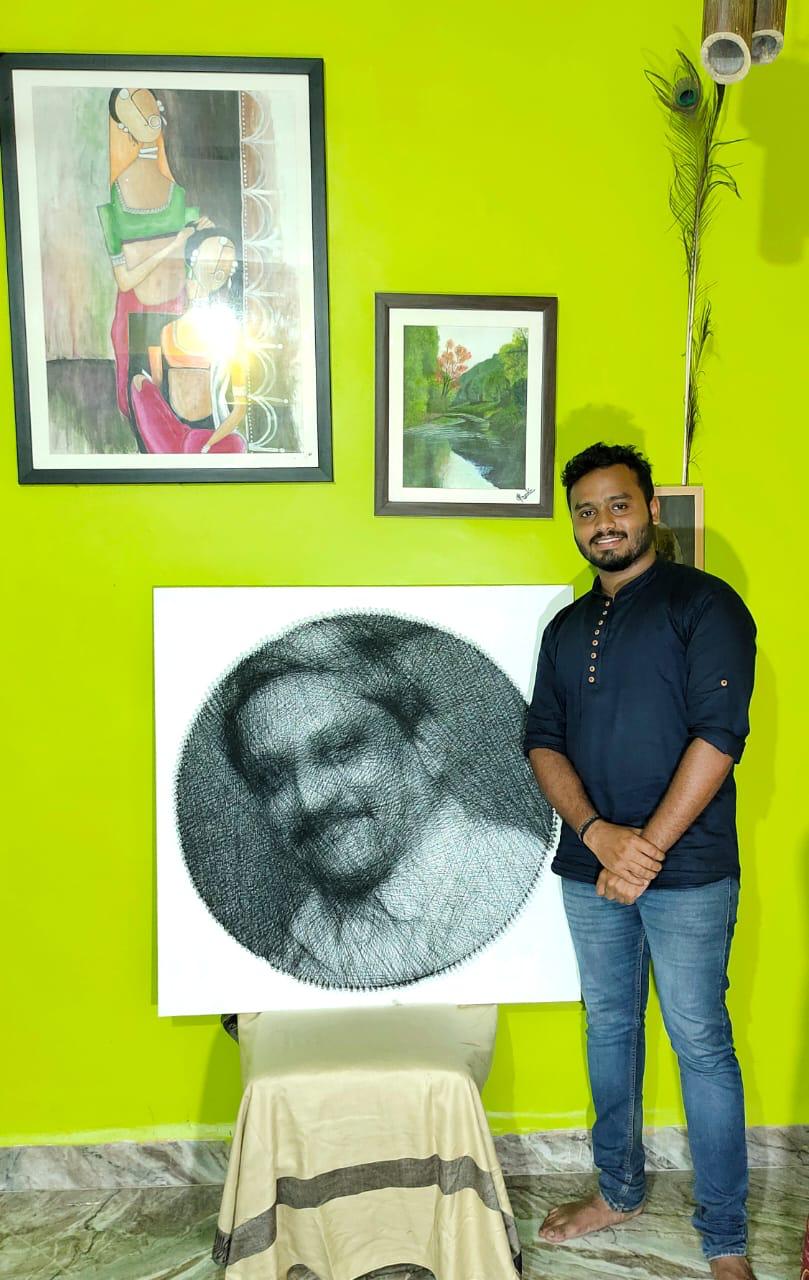
From the small town of Cacora-Curchorem, Pradul P Sanguekar has built an artistic practice that challenges conventional ideas of what can become a canvas. A self-taught artist, Pradul works with leaves, dice, cashew nuts, thread, pencil leads, stapler pins, watercolours and digital techniques, transforming everyday and discarded materials into intricate works of art.
At 26, he balances his creative pursuits with his profession as a Radiographer at a local hospital. While healthcare demands precision and composure, art has always been his instinctive form of expression. Raised in a simple middle-class family amid Goa’s natural surroundings and cultural traditions, he developed an early curiosity about creating something extraordinary from ordinary objects.
A Journey Built on Curiosity
Pradul’s artistic journey began traditionally with pencil and paper, but his curiosity soon pushed him beyond familiar forms. Rather than simply reproducing conventional subjects, he began wondering what could happen if art were created on unexpected surfaces.
Could a leaf become a canvas? Could a cashew nut carry a miniature painting? Could thousands of dice come together to form a recognisable face?
These questions became the foundation of his practice. The COVID-19 lockdown proved to be a defining period. With everyday life brought to a standstill, Pradul spent long hours experimenting at home, sometimes dedicating 12 to 15 hours a day to creating, failing and trying again. Without formal training, he learned through observation, experimentation and persistence, eventually developing techniques of his own. The experience transformed art from an interest into a way of life.
Finding Possibilities in Unconventional Materials
For Pradul, the material is an important part of the artwork itself. He is drawn to objects not because they are expensive or traditionally associated with art, but because they present a challenge.
A fragile leaf demands patience. Dice offer countless combinations of light and shadow. A cashew nut carries a distinctly Goan identity. Even something as mundane as a stapler pin can become part of an artistic experiment.
This approach gives his work a distinctive character. Instead of beginning with a conventional canvas, he often begins with a question: what can this object become?
The Patience of Leaf Carving
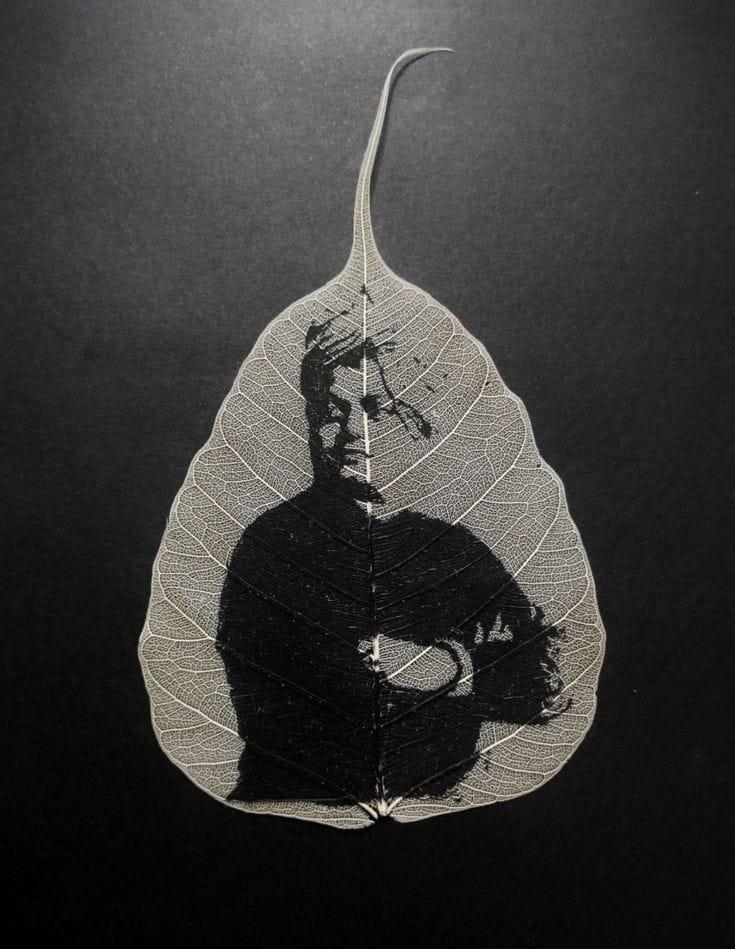
Among Pradul’s most intricate practices is leaf carving, a painstaking technique that requires an exceptionally steady hand. He primarily works with Chinar and peepal leaves, selected for their texture and structure.
Before the actual carving begins, the leaves have to be treated, dried and pressed for several days. Once prepared, Pradul uses a surgical blade to carefully remove sections of the leaf, gradually revealing the intended image. A single incorrect movement can tear the delicate surface and undo hours of work.
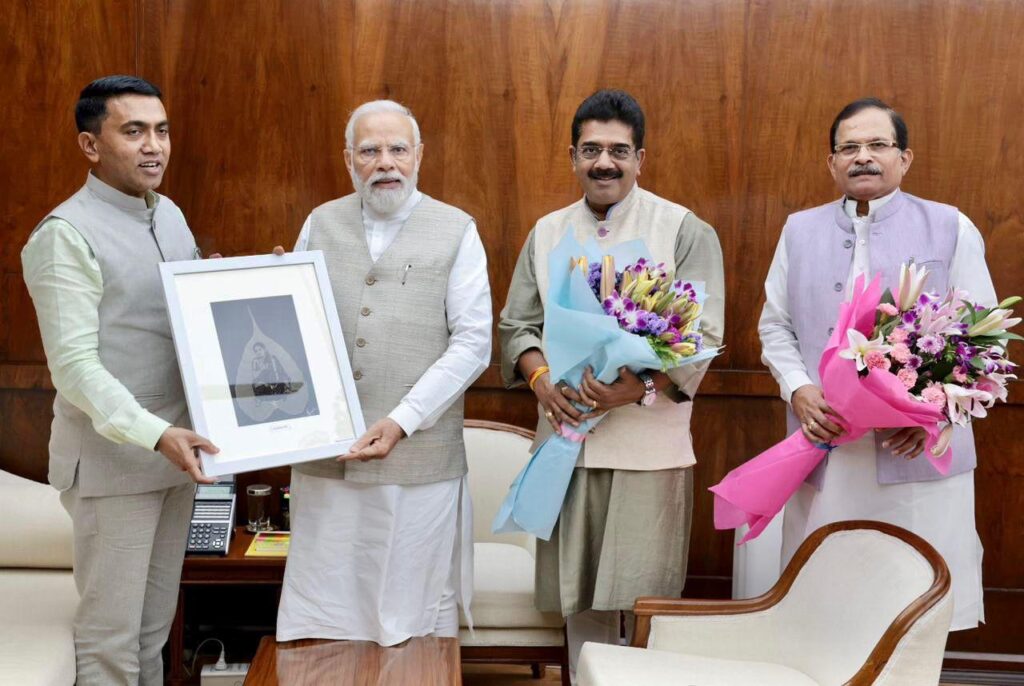
His leaf carvings featuring Gautama Buddha and Swami Vivekananda hold particular significance for him. Their teachings surrounding peace, inner strength and resilience resonate with the qualities he associates with the leaf itself.
Pradul developed the technique independently by studying numerous instructional videos and learning through repeated failures. His professional experience as a Radiographer also contributes to the precision required. The controlled movements and concentration demanded in healthcare have translated naturally into his delicate craftsmanship. For him, leaf carving is more than a technique. It is an exercise in patience and focus, almost a form of meditation.
Thousands of Dice, One Portrait
Another defining aspect of Pradul’s work is his large-scale dice art. Inspired by seeing examples of the medium internationally, he wondered whether such a project could be created in Curchorem.
The process begins digitally. Pradul pixelates a photograph and studies the tonal variations required to reproduce the image. Each face of a dice offers a different visual value, ranging from the lighter appearance of one dot to the darker effect created by six dots. He then maps the composition and determines the quantity and placement of each type.
The dice are subsequently positioned one by one. The result is essentially a giant three-dimensional puzzle. From a distance, the thousands of individual pieces merge into a portrait; up close, the work reveals the extraordinary number of elements that make up the image.
According to Pradul, the portrait often becomes recognisable only towards the final stages of the process, making patience as important as planning.
A Tribute to Shree Ram and Lord Hanuman
One of his most ambitious projects was an 8.5-by-12-foot dice portrait of Shree Ram and Lord Hanuman, created during the period of the Pran Pratishtha of the Ram Mandir in Ayodhya.
As celebrations took place across the country, Pradul wanted to create an offering rooted in his own home state. The project became his way of expressing devotion through his chosen medium.
The scale of the artwork was significant, but its meaning went beyond its dimensions. For Pradul, Shree Ram and Lord Hanuman represent devotion and dharma, and he wanted the artwork to convey the feeling that this celebration of faith could also be experienced within his own village.
When Art Became a Community Effort
The project soon grew beyond the artist himself. Residents, volunteers, children, neighbours and visitors participated by helping place the dice.
Even the financial contribution became collective. People donated small amounts, including ₹10 and ₹20, towards purchasing the dice required for the massive installation.
For Pradul, this was one of the most meaningful aspects of the project. What began as his artistic vision gradually became a collective creation belonging to Cacora.
The experience reinforced his belief that art does not have to remain within galleries or belong exclusively to trained artists. When it connects with something people care deeply about, it can become a shared expression.
Honouring a Goan Icon
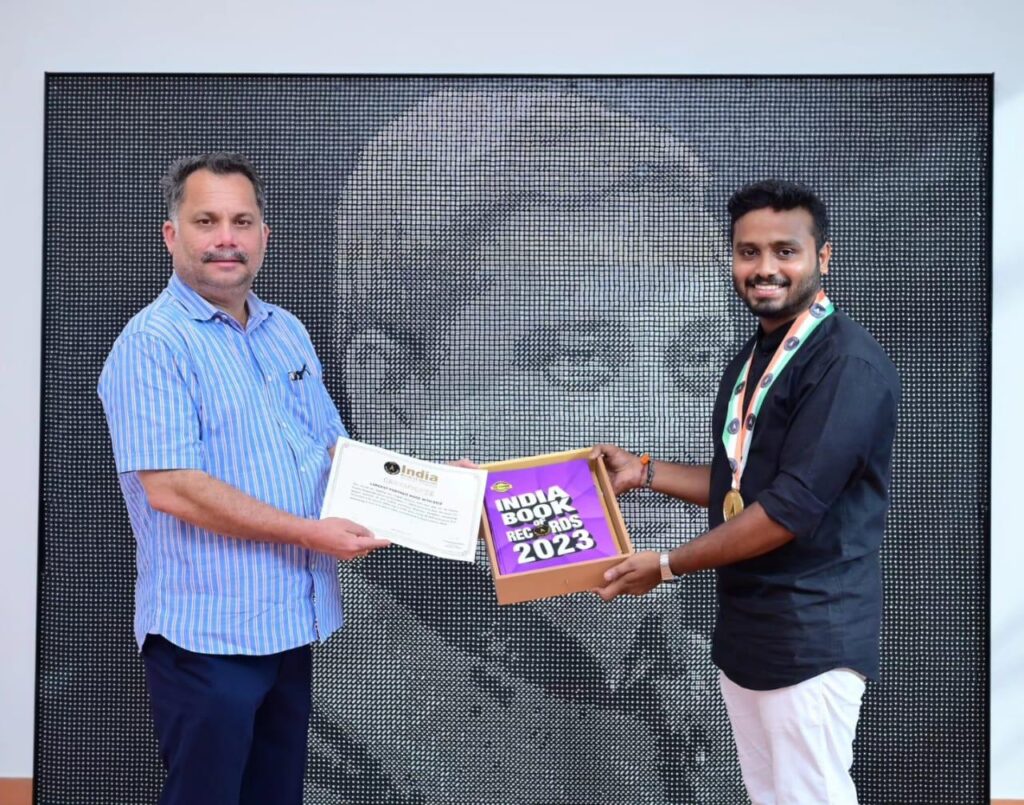
Pradul’s dice-art journey also led to an emotional tribute to late Shri Manohar Parrikar. Creating a portrait of the former Goa Chief Minister using 36,000 dice was his way of honouring a figure he regarded as an inspiration to Goans.
The work received recognition from the India Book of Records and The Book of World Records, marking an important milestone in his artistic journey.
For Pradul, these recognitions represent more than certificates. They symbolise the possibility of talent emerging from places that may otherwise remain outside the national spotlight. A young artist from Curchorem had demonstrated that an idea born in a small Goan town could achieve recognition on a much larger stage.
Precision from the World of Healthcare
Pradul’s profession as a Radiographer may appear worlds apart from his artistic practice, yet the two disciplines share an important quality: precision.Pradul’s profession as a Radiographer may appear worlds apart from his artistic practice, yet the two disciplines share an important quality: precision.
Radiography requires concentration, controlled handling of equipment and careful attention to detail. These qualities have become valuable when working with fragile leaves or positioning individual dice within a large composition.
Whether tracing the delicate vein of a leaf or placing a tiny component in a portrait, Pradul approaches the task with the same calm focus that his professional environment has taught him.
Healthcare has therefore become an unexpected influence on his artistic discipline, reinforcing his belief that even the smallest detail can determine the success of a larger picture.
Inspiration in Everyday Goa
Away from his work and art, Pradul finds inspiration in the world around Cacora. He enjoys spending time in nature, listening to music and observing the ways people express themselves.
Conversations with older members of his village are particularly meaningful to him, with their stories often providing creative inspiration. His surroundings continually offer potential subjects and materials, a fallen leaf, cashew nuts from a farm or even ordinary objects lying on a table.
This connection with everyday life keeps his work grounded in his Goan identity. Rather than searching exclusively for inspiration in conventional artistic spaces, he finds it in his community and environment.
A Dream for Goa
Pradul’s ambitions extend beyond individual artworks and record achievements. One of his biggest goals is to bring a Guinness World Record to Goa, specifically Curchorem, through his specialised leaf-carving work.
He also hopes to establish a small art space for children in the area, giving them an opportunity to experiment and discover their creativity without believing that expensive supplies are necessary.
At the heart of this vision is a simple philosophy: creativity does not depend on the price of the material. It depends on imagination, patience and the willingness to experiment.
For Pradul, every creation is part of a larger journey, one that began in Cacora with curiosity and continues through countless leaves, dice and everyday objects. His story is ultimately about finding extraordinary possibilities in ordinary things and proving that talent, dedication and originality can emerge from anywhere.
For this young artist from Curchorem, art is not merely a profession or pursuit. It is his way of expressing gratitude, identity and belief, his own form of prayer.