

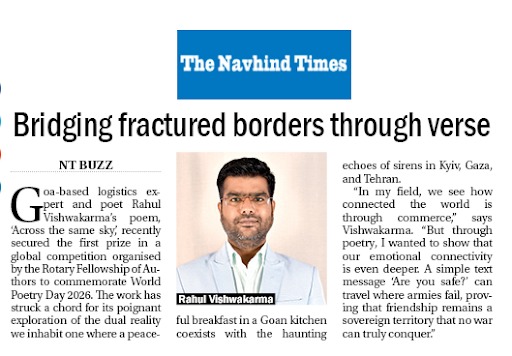
In the coastal town of Vasco da Gama, where the rhythm of the sea meets the quiet hum of everyday life, Rahul Vishwakarma stands at a rare intersection of worlds. A professional in international logistics and global trade, and a poet shaped by solitude and movement, his journey is one that seamlessly blends precision with introspection. He describes himself not just by profession, but as a seeker, a survivor, and a strategist, identities that echo through both his work and his words.
The Dual Life: Logistics and Literature
Rahul’s career in global trade places him at the heart of a vast, interconnected system. As a freight forwarder, he operates behind the scenes of global commerce, orchestrating the movement of goods across continents. He does not own ships or aircraft, yet he directs their purpose, ensuring that ambition travels from one shore to another. His role is both analytical and intuitive, translating the complexities of customs, regulations, and supply chains into seamless operations.
Yet beyond this structured world lies his poetic identity. Where logistics demands clarity and discipline, poetry offers him a space to reflect on the emotional undercurrents of human existence. For Rahul, these two domains are not separate; they inform one another. The precision of logistics shapes his writing, while poetry humanizes the mechanical world he navigates daily.
A Global Perspective on Human Connection
Years spent engaging with people across continents have deeply influenced Rahul’s worldview. Conversations with clients in distant ports and suppliers in foreign cities have revealed a simple but profound truth: beneath cultural differences, human nature remains constant.
He sees humanity as a shared system, diverse in expression, yet unified in essence. Whether in the bustling trade hubs of Europe or the manufacturing centers of Asia, he encounters the same desires: stability, purpose, and peace. This realization forms the philosophical backbone of his poetry, where borders dissolve and empathy becomes the central theme.
Rahul often describes his role as developing a “logistics of the soul,” an ability to sense not just business needs but human emotions. This intuitive understanding allows him to connect deeply, both in his profession and his creative work.
The Ocean That Sparked a Voice
Rahul’s poetic journey began not in a classroom or literary circle, but in the vast silence of the ocean. In 2015, after joining a research mission under India’s Ministry of Earth Sciences, he found himself aboard a vessel navigating the endless expanse of the Indian Ocean and Arabian Sea.
It was here, surrounded by nothing but horizon, that poetry found him. The absence of land, the rhythm of waves, and the quiet isolation created a space for introspection unlike anything he had experienced before.
He began documenting moments that words struggled to contain, the shimmer of moonlight on water, the tension between mechanical order and natural chaos, and the humbling awareness of humanity’s smallness within the vastness of nature. What began as observation soon transformed into expression. He returned from those journeys not just as a participant in scientific exploration, but as a poet who had discovered his voice.
A Style Forged Between Industry and Imagination
Rahul’s writing is marked by a distinctive fusion of industrial imagery and emotional depth. Where traditional poetry often leans on nature or romance, he finds metaphor in machinery and movement. Hope becomes a well-oiled gear, resilience the strength of a mooring rope.
His time at sea has also shaped what he calls a “horizon perspective.” His poetry does not dwell on trivialities; instead, it seeks expansive truths that connect individuals across geography and circumstance. There is a sense of scale in his work, an awareness of the infinite, that allows his writing to transcend the immediate and touch the universal.
Equally defining is his disciplined approach. He treats each poem like a shipment, carefully structured and purposeful. Every word carries weight, every line serves a destination, and the final emotion must arrive intact at the reader’s heart.
Themes Rooted in Reality
Rahul’s work consistently returns to themes of resilience, hope, and human connection. These are not abstract ideas, but reflections of lived experience. In the world of global trade, he witnesses how conflict disrupts lives, delayed shipments, uncertain futures, and the anxiety of those caught in systems beyond their control.
Yet even within these challenges, he observes an enduring human spirit. People continue to work, adapt, and hope. His poetry captures this quiet strength, offering a reminder that even in fractured systems, humanity finds ways to rebuild.
For Rahul, poetry becomes a bridge, one that connects people beyond politics, beyond borders, and beyond circumstance. It is a map without boundaries, guided by empathy rather than geography.
The Process: Where Logic Meets Longing
Rahul writes from a space where structure and emotion intersect. His poems emerge not from isolation, but from the friction of daily life. A conversation, a moment of tension, or even the rhythm of work can ignite a line.
He describes his creative process as a “loading system,” where feeling acts as fuel, the first line sparks motion, and the moment defines direction. By the time he begins writing, the essence of the poem is already formed, he simply ensures its delivery.
His work draws equally from experience, observation, and imagination. This blend allows him to navigate complex realities with both clarity and sensitivity, transforming the harshness of global trade into narratives of connection and possibility.
Empathy as the Core
At the heart of Rahul’s poetry lies empathy. He writes not to escape reality, but to understand it, and to help others do the same. Through sensory detail, vulnerability, and a tone of quiet companionship, he invites readers into his perspective.
His poems often feel like conversations rather than declarations, offering reassurance in moments of uncertainty. By sharing his own solitude and introspection, he creates space for others to confront their own experiences.
Beyond Words
Outside of poetry, Rahul identifies as a traveler, a listener, and a coastal dreamer. His connection to the shores of Goa, combined with his exposure to diverse cultures, continues to shape his creative process. Music, movement, and observation are not separate from his writing, they are integral to it.
A Message That Resonates
Ultimately, Rahul Vishwakarma writes to remind readers of a simple yet powerful truth: no one is alone. Across oceans, across conflicts, and across differences, there exists a shared human experience.
His poetry does not promise escape, but it offers strength, the kind that comes from recognizing one’s place within a larger whole. It speaks to the resilience that defines humanity and the quiet connections that bind it together.
In a world often divided by borders and uncertainty, Rahul’s voice stands as a steady reminder that beneath it all, we are part of the same story, moving forward, together.