
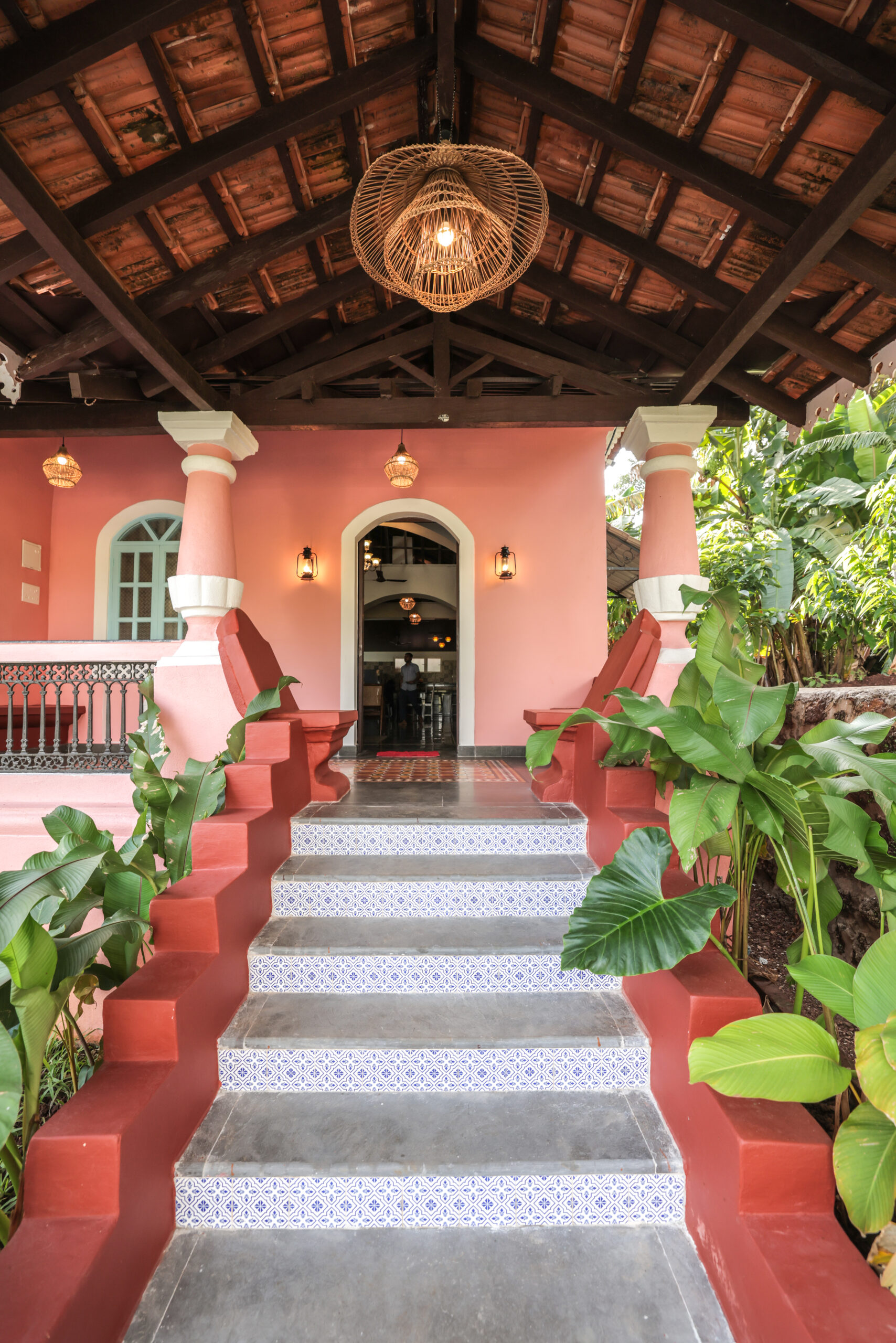
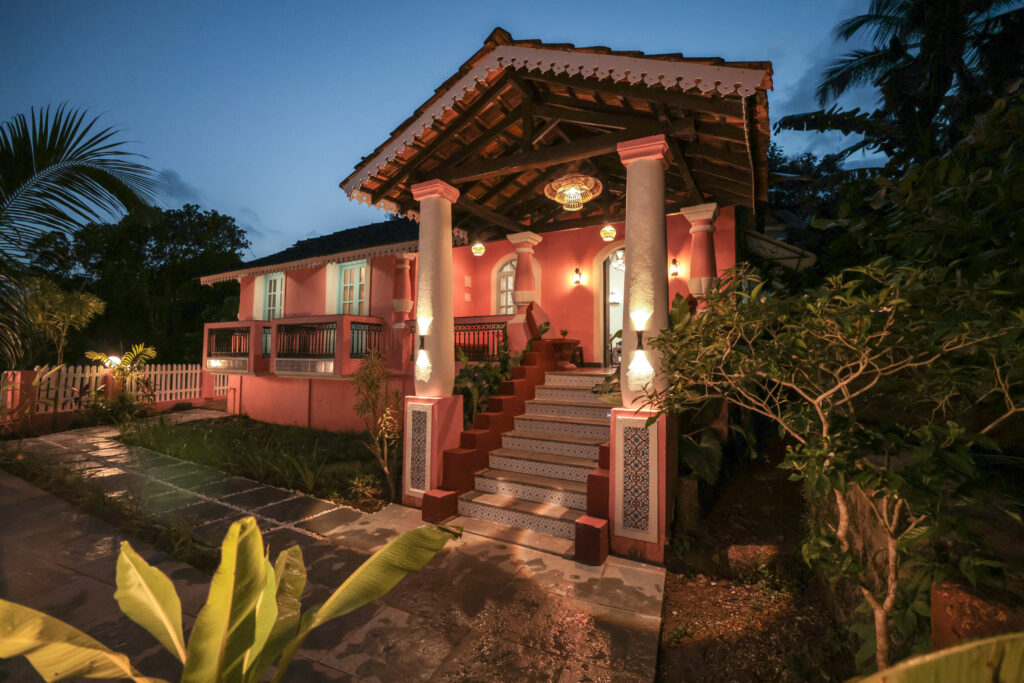
Tucked away in the green surroundings of Carona, Aldona, The Village Casa is a restored Portuguese-era home that offers something increasingly rare in Goa, a chance to slow down and experience the character of an old village house. Set beside fields, a waterway and lush tropical vegetation, the heritage villa combines its original architecture and rustic charm with the comforts of a contemporary holiday home.
The property is a deeply personal project for Vivian John Desouza, an IT professional, wedding photographer, hobbyist artist and traveller. The house belonged to his great-grandfather and has remained part of his family for generations. Having been born there, Vivian grew up with a personal connection to the property before his family moved to a new home in 2012. The old house subsequently remained unoccupied for nearly 12 years until he decided to bring it back to life in 2024.
Restoring a Piece of Family History
Believed to have been built in the late 1800s, the house was once part of a cluster of six or seven neighbouring homes. As the surrounding families gradually moved closer to the main village road, the property became the only one of its original group to remain standing. Its secluded setting, however, has become one of its greatest strengths.
The original structure reflected the practical character of traditional Goan homes. Built using stone and mud, it had thick walls, stone flooring and a traditional cow-dung-finished floor. The property was once home not only to the family but also to poultry, pigs, goats, cats and dogs.
The decision to restore it was influenced by Vivian’s own travels. An avid traveller, he regularly undertakes long road trips with friends and prefers staying in homestays and farm stays that allow him to understand the local culture, food and traditions of a destination. Experiencing such properties elsewhere made him realise that his own ancestral home offered the setting and character needed to create a similar experience in Goa.
With ideas gathered over years of travel and visual inspiration, Vivian worked alongside an architect friend to develop the restoration. The objective was not to turn the house into an entirely new property, but to preserve as much of its original character as possible while introducing the conveniences expected of a modern holiday stay.
Restoration presented its own challenges. Since the house was constructed with interconnected mud and stone walls, removing a single stone could cause several others to loosen or fall. Vivian’s uncle, a structural and restoration civil engineer, played an important role in addressing these challenges and ensuring that the work could progress safely.
The resulting aesthetic draws inspiration from Goa’s Fontainhas neighbourhood in Panjim and the French colonial character of Puducherry, particularly in its colour palette, while the landscaping embraces a distinctly tropical identity.
A Setting Shaped by Fields, Water and Trees
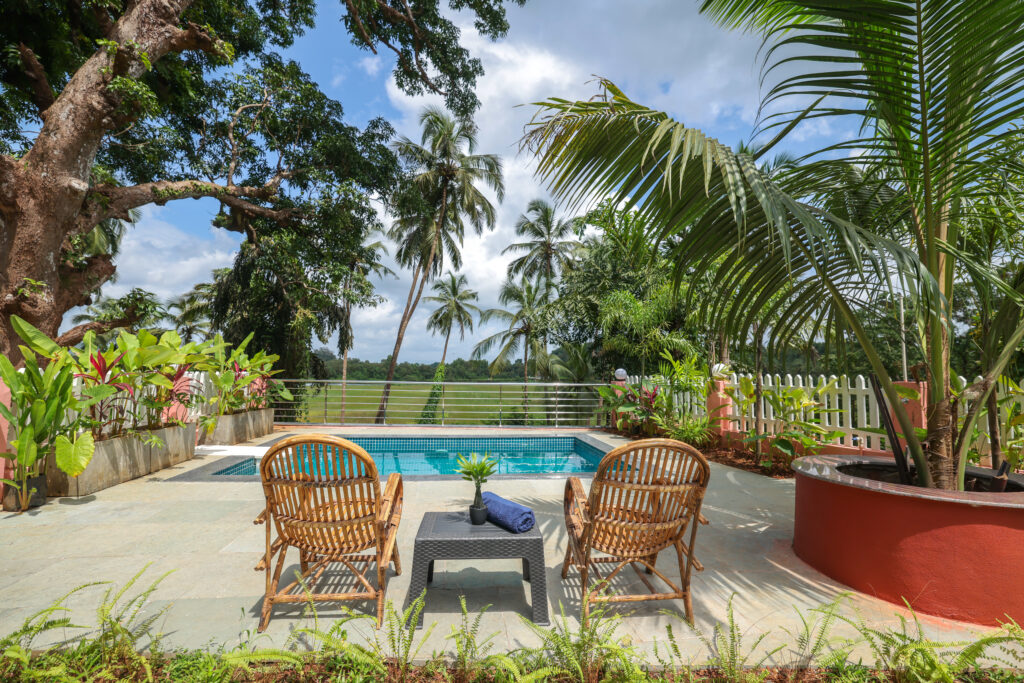
Carona, in Aldona, is known for its greenery, waterways and rural surroundings, and The Village Casa sits within this landscape rather than apart from it. The property overlooks fields and a waterway connected to the wider Mandovi river system, creating a setting that is peaceful and naturally secluded.
The adjoining land has been shaped by generations of the Desouza family. Coconut, cashew and mango trees planted by Vivian’s grandmother and later his father continue to thrive around the property. Two brown-rice fields lie below the house and remain cultivated, while pepper grows on the cashew trees.
The seasonal harvest adds another dimension to the experience. Cashew fruits are collected during the season, with the nuts sold and the fruit traditionally contributing to the production of urrack and feni. Guests visiting at the right time of year can also experience aspects of this agricultural rhythm, from collecting cashews and pepper to tasting fresh niro.
An Invitation to Slow Down
For many guests, the most striking feature of The Village Casa is not an amenity but the silence. The thick mud-and-stone walls and stone floors naturally help keep the house cool, while the absence of immediate neighbours creates an unusual sense of privacy.
Instead of traffic and urban noise, guests hear the movement of trees in the breeze and the occasional calls of the property’s resident peacocks and hornbills. For visitors accustomed to metropolitan cities or busy tourist destinations, this quietness becomes an integral part of the stay.
The property has been designed for families and groups of friends, accommodating up to 10 guests across three bedrooms with attached bathrooms. A hall, fully equipped kitchen, laundry room, two balconies, garden and open areas complete the home, while a tropical landscape of broad-leaf plants and mature trees surrounds it.
Modern Comforts in a Heritage Setting
While the house retains its old-world character, guests have access to the facilities needed for a comfortable contemporary stay. The outdoor plunge pool measures 5 by 3 metres and has a depth of five feet, providing a private space for cooling off and relaxing.
All three bedrooms are air-conditioned, while dual internet connections and Wi-Fi make the property suitable for workations and longer staycations. Other facilities include a fully equipped kitchen, washing machine, solar water heating with round-the-clock hot water and board games.
The Village Casa is also pet-friendly. Breakfast is provided, while additional meals can be arranged through Vinod, the property’s caretaker and cook. His chicken chilly has become particularly popular among guests. The property also has a tie-up with a local Goan restaurant for food orders, while cafés, supermarkets and the main market are only a short drive away.
Beyond the Villa
Although many guests are happy to spend their time by the pool or simply unwind at the house, the surrounding landscape offers plenty of opportunities for exploration.
Two kayaks are available for longer-stay guests who wish to explore the backwaters below the property. Cycling excursions to nearby Charao and Divar can be arranged on request, while village walks offer a slower way of discovering the area. Two scenic bridges nearby also provide picturesque settings for photography.
For those interested in the local environment, fishing and crab catching are among the activities guests can enjoy. During the agricultural season, visitors may participate in collecting cashews and pepper, offering an opportunity to engage directly with the traditions and produce of the region.
Where Heritage Meets Personal Expression
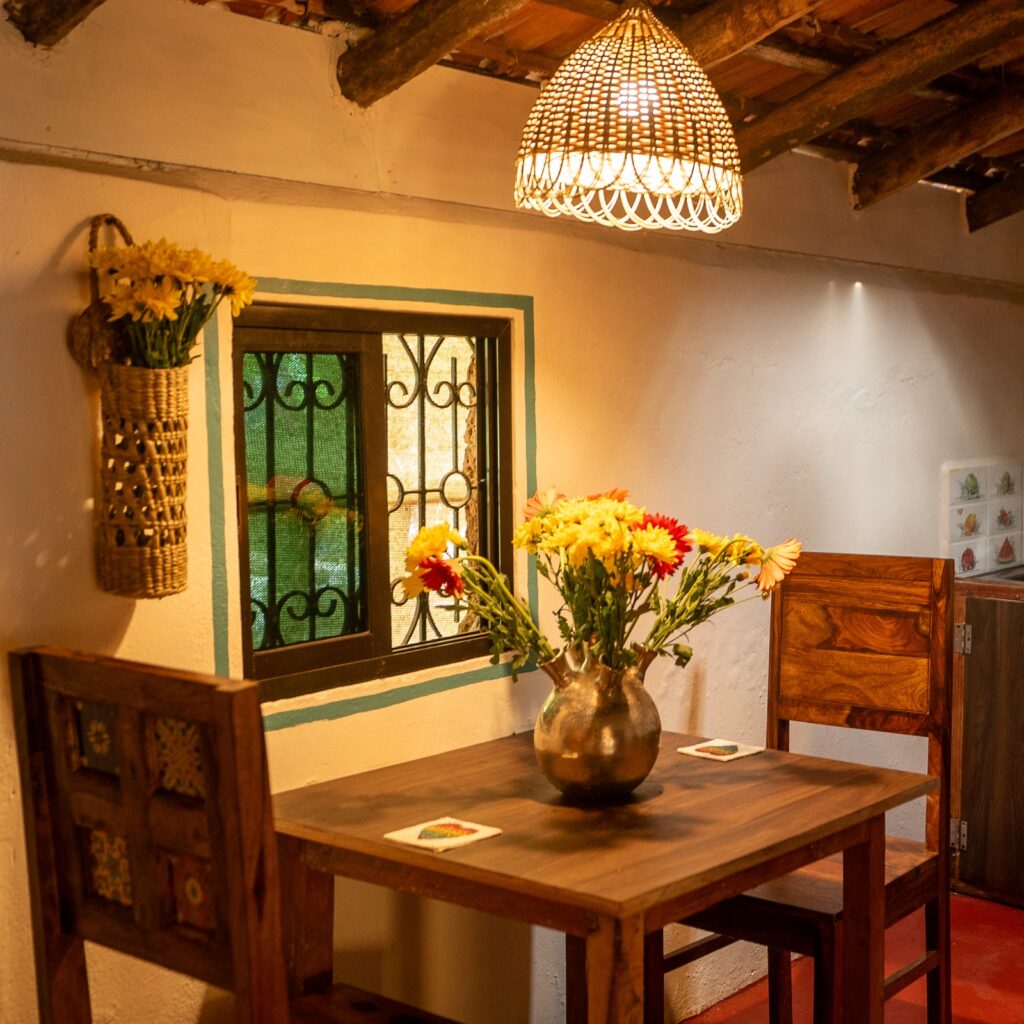
Several details throughout the house reflect its history. Guests particularly appreciate the Italian-inspired tile work in the balconies, traditional red oxide balcao seating, high walls and wooden roof structure. The interiors have been kept minimal, allowing the architecture and materials of the original house to remain prominent.
Vivian’s own artistic sensibility is also visible within the property. One of the artworks is a three-dimensional leaf composition created by him using leftover wall putty from the restoration, wood from old beds and cupboards, and leaf forms inspired by the tropical plants surrounding the house. It is a personal interpretation of the property and its natural setting, created from materials connected directly to its restoration.
The family’s involvement extends beyond the physical restoration. Guests may receive home-grown brown rice and lentils prepared by Vivian’s mother, while his father often shares stories and memories connected to the house and its history. These small interactions help make the stay feel less like a conventional holiday rental and more like an introduction to a family home.
A Retreat Away from the Mainstream
The Village Casa is intended for those who value space, nature and authenticity over the bustle of conventional tourist destinations. Families, couples, groups of friends, nature lovers and travellers seeking a quieter side of Goa can find a different kind of holiday here, one shaped by village life, heritage architecture and the surrounding landscape.
Having opened its doors in November 2025, the property is still evolving. Future plans include creating an outdoor seating area where guests can enjoy morning tea and coffee, as well as evenings around a barbecue beneath the stars and fairy lights. Additional recreational elements, including board games such as carrom, are already being introduced.
At its heart, however, The Village Casa remains less about constant additions and more about preserving a feeling. It is a family home brought back to life, where the cool interiors, agricultural surroundings, traditional architecture and unhurried pace offer guests the opportunity to disconnect from everyday pressures. In doing so, it presents a quieter, more intimate way to experience Goa, one that begins not with sightseeing, but with simply being present.